With Thanksgiving approaching, a turkey that’s still frozen doesn’t have to upend dinner plans. The U.S. Department of Agriculture says cold-water thawing takes about 30 minutes per pound, making it a faster option than the refrigerator for cooks who can put the bird in the oven as soon as it thaws (USDA thawing guidance).
“Right now it’s all about thawing,” Javier Reyes of the Butterball Turkey Talk-Line told “Party Line” listeners on WILO and Boone 102.7 FM. “We get a lot of questions about how to thaw turkey, how long is it going to take.” The conversation also covered whether to cook stuffing inside the bird and why a food thermometer is more useful than the clock for checking doneness.
If the turkey is still frozen
“It’s not safe to use warm water,” Reyes said. For the cold-water method, keep the turkey in its original packaging if it’s leakproof, or put it in a leakproof bag. Submerge it in cold tap water, change the water every 30 minutes and cook the turkey immediately after thawing. At about 30 minutes per pound, a 10-pound turkey takes about five hours and a 20-pound bird takes about 10 hours (USDA thawing guidance).
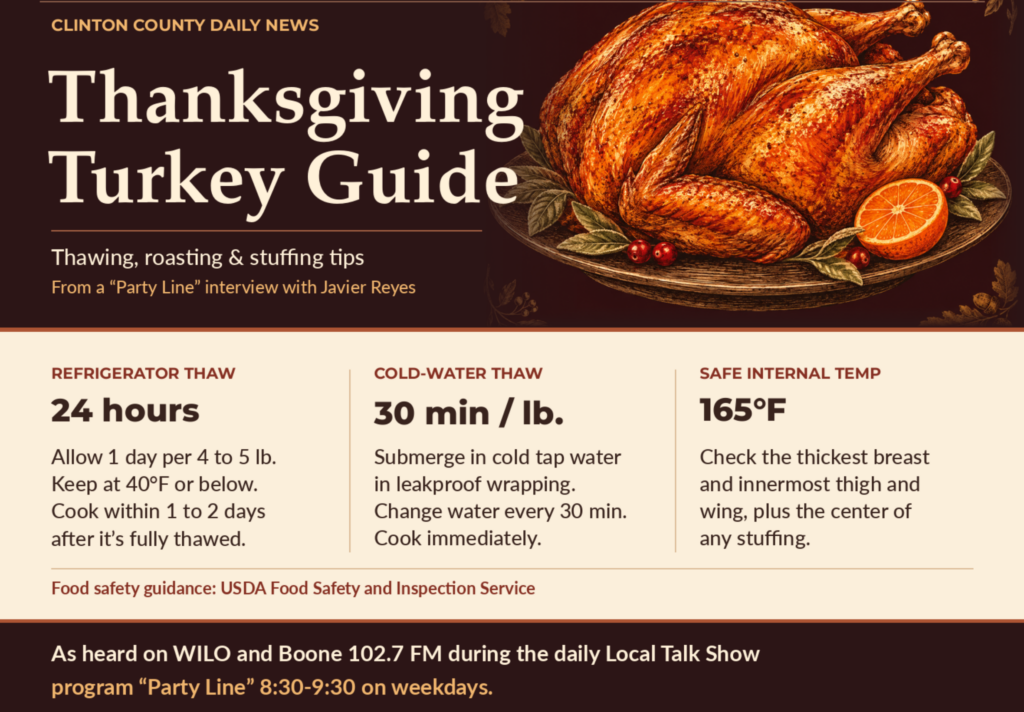
If there’s time to use the refrigerator, USDA recommends allowing about 24 hours for every 4 to 5 pounds at 40°F or below. Set the wrapped turkey on a tray to catch drips. Once fully thawed in the refrigerator, the turkey should be cooked within one to two days, not the four days mentioned in the interview (USDA’s Thanksgiving thawing guide).
Reyes said some callers tell the hotline they’ve left their turkey on the counter or forgotten it in the car. A bird can still be frozen in the middle while the outside is warm enough for bacteria to multiply, according to USDA thawing guidance.
The host raised another common problem: What if there’s still ice inside when it’s time to cook? USDA advises against rinsing raw turkey because splashes can spread bacteria around the kitchen (USDA’s Thanksgiving food-safety tips). An unstuffed turkey can go straight into the oven from frozen, but USDA says to allow about 50 percent more cooking time than for a thawed bird and use a thermometer to check for doneness (USDA’s guide to roasting from frozen).
What the thermometer should say
Reyes said he roasts his own turkey in an open pan and uses a food thermometer rather than relying on a pop-up indicator. USDA recommends an oven temperature of at least 325°F. Check for at least 165°F in three places: the thickest part of the breast and the innermost parts of the thigh and wing. Keep the thermometer probe from touching bone (USDA’s turkey temperature guide).
USDA recommends baking stuffing separately. If you do cook it inside the bird, stuff it immediately before roasting, not the night before, and check that the center of the stuffing also reaches 165°F (USDA stuffing guidance).
Where to get help
Cooking time depends on the turkey’s weight and whether it’s stuffed, Reyes said. “But that’s what we’re here for,” he said, inviting cooks with questions to call. The Butterball Turkey Talk-Line is available at 1-800-BUTTERBALL (1-800-288-8372) and is scheduled to take calls from 7 a.m. to 7 p.m. Eastern on Thanksgiving Day.
As heard on WILO and Boone 102.7 FM during the daily Local Talk Show program “Party Line” 8:30-9:30 on weekdays.