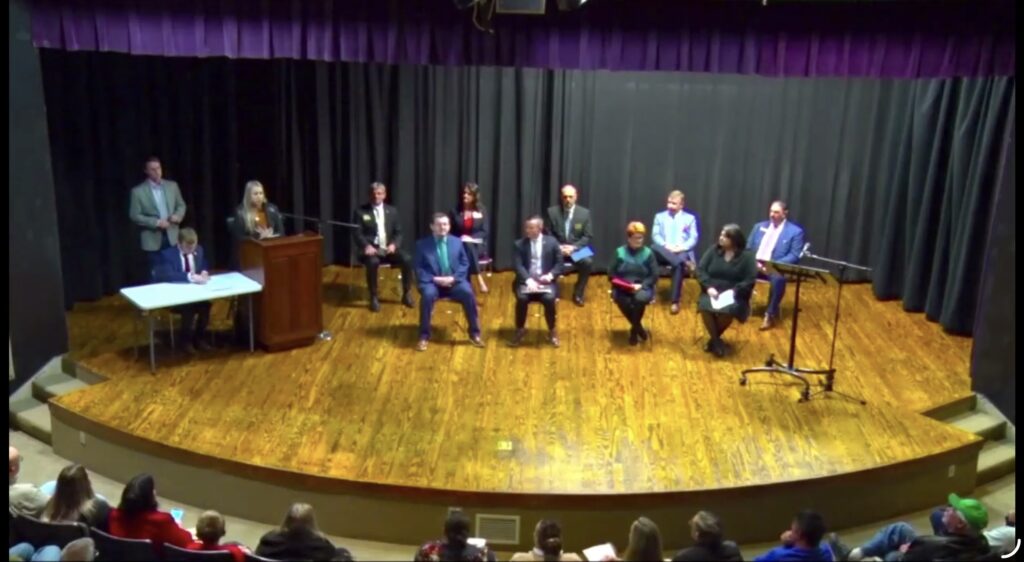
Clinton County voters heard sharply contrasting visions for law enforcement, the courts and state policy Tuesday night as a bipartisan local candidate forum filled the Skanta Theatre at the Frankfort Community Public Library ahead of the May 5 primary election.
About 170 people packed Skanta Theatre and nearly twice that many (310) watched on Hoosierland TV, presented by Clinton County Chamber of Commerce. The forum is available now to watch on demand HERE.
Forum sets tone for primary season
Hosted by the Clinton County Republican Women’s Club and moderated by Indiana Republican Party Secretary Aaron Minnich, the event featured candidates for county assessor, auditor, prosecutor, sheriff, and Superior Court judge, along with a Democratic candidate for State Representative District 41. Minnich stressed that the evening was designed to inform, not to endorse.
“Our goal tonight isn’t to crown a winner, but to ensure that every citizen leaves here with a clear understanding of the candidates’ platforms before the primary election this spring,” Minnich said, adding that his role was “to serve as a facilitator for a conversation that belongs to you, the voters.”
Minnich outlined strict rules on time limits, decorum and audience participation, noting that speakers would receive yellow and red card warnings and asking that “remarks [stay] focused on policy and record rather than personal attacks.” He asked the audience to hold applause until the end so that “we hear as much from the candidates as possible.”
Clinton County Republican Women’s Club President Krista Stillwell welcomed the crowd and emphasized the bipartisan nature of the forum. She encouraged residents to submit written questions for the sheriff’s and Superior Court races, where contests have drawn multiple candidates this year.
Assessor: explaining rising property values
Incumbent County Assessor Jada Ray opened the candidate statements by focusing on how her office handles rapidly changing property values.
Ray, a lifelong Frankfort resident with 25 years in the assessor’s office, said she is a Level III certified Indiana assessor-appraiser and currently serves as president of the West Central District of the Indiana County Assessor’s Association. She said continuing education is “extremely important to me” as assessment rules evolve.
“With statewide updates to assessed valuations and ongoing legislative changes, property taxation has become more complex and at times frustrating for many homeowners,” Ray said. “I understand those concerns and take them seriously.”
Answering a question on the 2026–2030 cyclical reassessment, Ray described the state‑mandated “trending” process. “In Indiana, assessments are based on market value as required by the Indiana Department of Local Government Finance,” she said. “Each year we’re required to review all the sales from the prior year all across Clinton County. We analyze arm’s length sales…and compare those sales to current assessed values.”
“If we see that homes in particular neighborhoods are consistently selling for more than their assessed value, state guidelines mandate that we apply a trending factor to bring assessments in line with the market,” Ray explained. She said trending factors are reviewed and approved by the DLGF (Department of Local Government Finance) and encouraged taxpayers to “come and talk to us” if they have questions about their property record cards.
Auditor: managing uncertainty and costs
Former auditor and former State Representative Jacquie Clements, now running again for Clinton County Auditor, framed the next four years as a test of the county’s financial resilience.
“I believe the most critical fiscal challenge facing Clinton County over the next four years will be maintaining essential services in the face of revenue uncertainty and rising costs,” Clements said. She pointed to property tax reform discussions, local income tax changes, fluctuating assessed valuations, and “increasing public safety and infrastructure costs” as pressures on the county budget.
Clements currently works for the Association of Indiana Counties as Director of Planning and Professional Development, where she said she “work[s] closely with dozens of county auditors and county councils” on budget best practices and serves as a registered lobbyist at the Statehouse.
“For Clinton County, the key challenge will be balancing long‑term financial sustainability with the immediate needs for residents,” she said, citing public safety, staffing, infrastructure and employee retention as priority areas. Having served as auditor before, she said, “I won’t need a learning curve. I understand the financial systems, budgeting process, fund structure, internal controls, and statutory responsibilities.”
Prosecutor: balancing safety and treatment
Republican prosecutor candidate Chris Vawter said his campaign is driven by “two reasons: I’m very passionate about the job and I’m passionate about this community.” Vawter began working in the Clinton County Prosecutor’s Office in 2014 while still in law school and has served there as an attorney since 2016.
He said years in the criminal justice system have shown him “the good, the bad, the challenges, but also the different tools we have available to us” to address crime and recidivism. “My personal belief and feeling is that public safety will always remain the starting point,” Vawter said. “When someone commits a serious crime, especially against children, elderly, or the most vulnerable in our community, accountability must come first.”
At the same time, he said, “many repeat offenders I see daily, particularly nonviolent ones, [are] usually oftentimes tied to different addictions or mental health disorders,” and the system must address those underlying issues. Vauter pointed to his service on local nonprofit boards as connections he hopes to use “to solve those issues” by coordinating with treatment and community groups.
Looking ahead, he noted that “you’re going to have at least two new judges” in coming years and said he wants “to work with them to develop new plans in place to make Clinton County a safer, better place.”
Statehouse race: broadband, utilities and rights
Democrat Jackson Hayes, running in House District 41, told the audience he is “a homebody” and “a nerd” who would “rather be at home playing video games,” but felt compelled to run after seeing “a horrifying and deliberate attack on the resources that me and my family need to survive.”
Hayes, speaking in a district that includes agricultural and small‑town communities, highlighted access to health care, public schools, libraries and utilities. “The hospitals have been defunded, the public schools and public libraries have been attacked and forced to change how they help our children and our families,” he said.
On rural broadband, Hayes said recent fiber deployments in Frankfort show what is possible. “The goal of the state should be to encourage companies to spread their services as far as possible to rural communities and even out into the middle of nowhere,” he said.
He also argued for local energy resilience. “We have an abundance of Indiana wind and sunshine, and so solar and wind energy are ways to reduce the costs of electrical utilities and allow us to be self‑sufficient as a community so that we’re not reliant on the statewide grid,” he said.
Hayes pledged to “advocate for bodily autonomy,” protect minorities’ freedoms, and “ensure that local communities have all of the money that they need in order to provide equal and fair and equitable ability for everyone to search for the happiness that they deserve in life.”
Superior Court Judge: law, fairness and rehabilitation
Two Republicans, Thomas “Tom” Little and Shawn Rountree, shared their backgrounds and judicial philosophies as candidates for Clinton County Superior Court Judge, a seat that will be open in 2026.
Little, a Frankfort native and longtime local attorney, said he left a corporate career selling wire and cable for a Fortune 500 company to attend law school because he wanted his “life’s work to help others.” Returning to Clinton County after graduating, he re‑engaged through both legal practice and volunteer organizations such as the Humane Society, YMCA and Frankfort Jaycees.

“It’s a unique position in the fact that you can wake up every day and have an opportunity to really make a difference in somebody’s life,” Little said of the judgeship. “You can help people, you can try to resolve differences in people, you can make a family life better.”
Asked how he would balance the letter of the law with fairness and compassion, Little said his experience in multiple courts has taught him that “my clients and everybody who comes in front of the court, they just want to be heard.” Regardless of the outcome, he said, people should leave with “the sense that their case has been heard” by “a judge that’s listening, that’s compassionate, that’s understanding.”
On addiction and mental health, Little praised existing local organizations and said the court must work “in concert with these people and organizations” because “you can’t do them alone. It has to be a unified effort.” He said a local drug or alcohol court could bring “massive funding” from the state and help strengthen rehabilitation options.
Rountree, an attorney who has practiced in Clinton County since 2012, emphasized his 23 years in law and roots in the local community through his wife’s Frankfort family and their five children. “This is my home,” he said. “This is where I’ve laid my roots with my kids. Our family is here, we have every intention to stay here forever.”
He told voters that consistent application of the law is itself a form of fairness. “If every person that comes before the court is treated with the same standards as far as the rule of law, you know it’s going to be applied in your case as everyone else’s,” Rountree said. “Wealth, poverty, whatever it may be, your gender, those things are not factors. The factors are what is the law and how do you apply it to a set of facts.”
On rehabilitation, Rountree pointed to existing jail‑based programs. He called the J‑CAP addiction‑recovery initiative “a phenomenal program” that gives incarcerated people “a good foundation” before they move on to home detention or probation and said the court should ensure defendants are connected to inpatient and outpatient services to reduce repeat offenses.
Sheriff’s race: leadership, culture and public safety
Three Republicans—Brendon Bright, Ashley Kelly and Jake Myers—shared their backgrounds and management philosophies in the race for Clinton County Sheriff, a contest that has drawn wide interest county‑wide.
Bright, a Rossville native and longtime officer, traced a career that began at the Sheriff’s Office in 2002 and included promotions to sergeant, lieutenant and captain of detectives before his 2020 retirement. He now serves as an investigator in the Prosecutor’s Office and part‑time town marshal in Kirklin, supervising several deputies.
“It’s important I didn’t step out of public service. I just changed my approach on how I could serve Clinton County,” Bright said. He described his philosophy as “servant leadership,” which he defined as “treating people fairly how you would want to be treated” and “never asking somebody to do something that you won’t do yourself.”

That approach, he said, means “building morale by equipping employees with the tools they need to succeed, prioritizing mental health and wellness, and building a culture where people are proud to work.” Bright told voters, “This campaign isn’t about politics, it’s about professionalism, it’s about accountability, and it’s ensuring that Clinton County has a sheriff who is prepared, experienced, and committed to serving the community with integrity.”
Kelly, who moved to Clinton County in 2009, highlighted her experience as jail matron and her role in developing programs and revenue streams inside the county jail. A Purdue graduate with a law and society degree, Kelly is a former Indiana State Police trooper who said she finished “top of my class” at the 68th ISP Recruit Academy.
She told the audience she helped build the federal inmate housing program that “has brought millions of dollars in revenue and added numerous jobs in public safety.” Kelly said she also sourced grant funding that led to implementation of the Jail Chemical Addiction Program, one of 13 such programs in the state, and worked to bring in a nonprofit mental health provider so that “we now have mental health in the Clinton County jail 40 hours a week.”
“Recovery starts inside the walls of our facility,” Kelly said. “I believe it is the responsibility of the Sheriff to implement real change through evidence‑based programming that will save lives and return individuals to our community.” Alongside program work, she said she runs the front office, manages vendors, maintains federal compliance and handles “our eight‑plus‑million dollar budget.”
Myers, a Frankfort native and veteran Frankfort Police Department officer, told voters that “family, faith, and service are central to who we are” and that “a safe community is a foundation for making Clinton County the best place to live and raise a family.”
“I was raised in a family that served this county for decades,” Myers said, adding that public office “demands integrity, independence, and accountability.” Over a 28‑year career, he said, he has held supervisory roles as sergeant, lieutenant and captain, graduated from the FBI National Academy, worked as a school resource officer, and helped build outreach initiatives such as the Citizens Police Academy.
The sheriff’s office, he argued, “should be professional, principled, and focused on public safety, not politics.” If elected, Myers said he would “invest in our deputies and jail staff through training, morale support, and career development,” strengthen partnerships to “aggressively fight crime and drug activity,” and “ensure fiscal responsibility while supporting rehabilitation programs that reduce repeat offenses and make our county safer long term.”
Asked about his management background, Myers said the sheriff’s office is “a large complex organization and leading it requires more than just wearing a uniform. It requires real management experience.” He said his years handling staffing decisions, operational priorities and “complex problems unfolding under pressure” have shown how decisions at the top “directly affect morale, safety, and even taxpayer costs,” and pledged to “restore a culture of accountability and trust within the Sheriff’s Office.”
As the evening drew to a close, Minnick reminded voters that the forum was only a starting point. He urged residents to continue asking questions and to carry the night’s conversations into the voting booth when Clinton County’s 2026 primary election opens at local vote centers in May.
Watch the Forum on demand from Hoosierland TV HERE
We are pleased to present the forum on Hoosierland TV. Mike Hall produced the program and will also produce the Hoosierland production of the forum Thursday evening. This broadcast was made possible by the Clinton County Chamber of Commerce and the following partners: