
FRANKFORT, Ind. — Nine Girl Scouts from Troop 50435 marked the completion of a yearlong service project this week, cutting the ribbon on a new pollinator garden at Camp Cullom they designed, built and planted almost entirely by themselves.
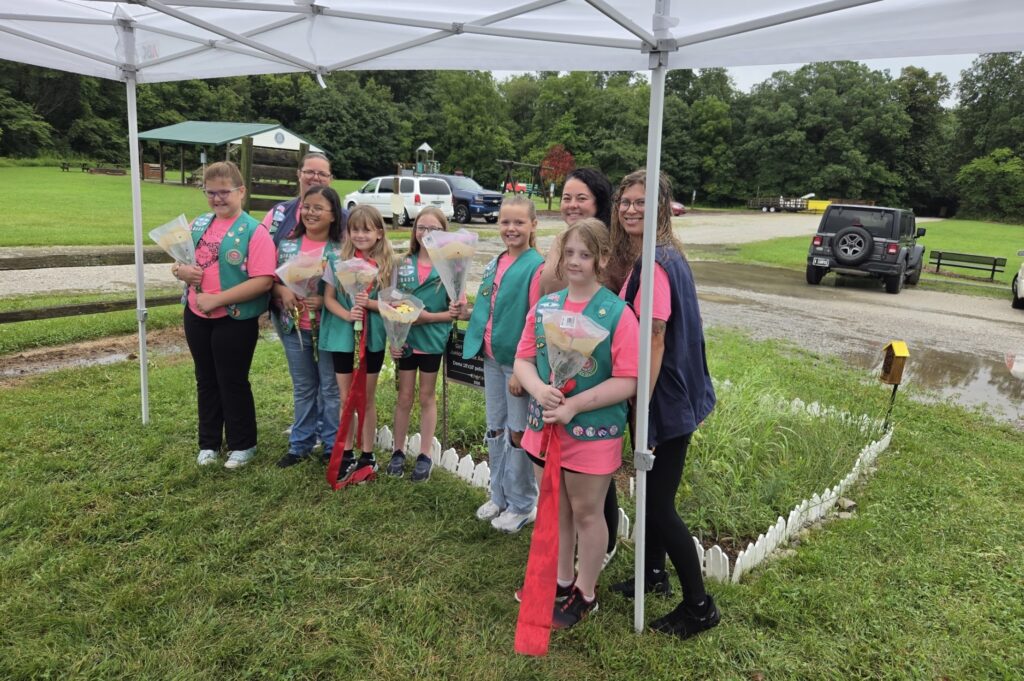
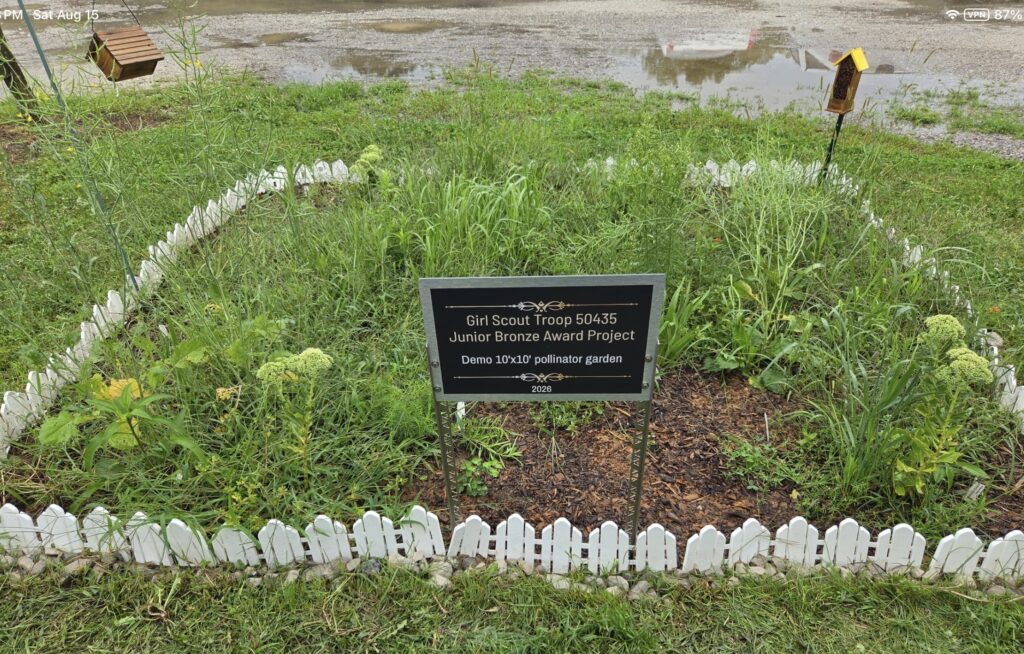
The 10-foot-by-10-foot demonstration garden, tucked near the camp’s Museum and Nature Center not far from the new beehive and enclosed by a white picket fence, serves as the girls’ Girl Scout Junior Bronze Award project — the highest honor a fourth or fifth grader can earn in Girl Scouting.
“The bronze award is kind of like getting their feet wet, learning how to manage a project,” said Becky Cole, troop leader of Troop 50435, which is based out of Clinton Prairie but draws roughly 80 active girls in grades K-12 from schools across all four county school districts.
Cole explained that the bronze, silver and gold awards are Girl Scouting’s equivalent of the more widely recognized Boy Scout ranks. “A gold award is the equivalent of a Boy Scout Eagle Award,” Cole said. “If you have a gold award and you go into the military, you start out as an officer because you have that rank.”
The bronze award is completed as a team project for fourth and fifth graders, the silver award can be tackled individually or by a small group of two or three girls, and the gold award is led by a single Girl Scout who plans the project herself, recruiting others to help carry it out.
All three awards, Cole said, share one requirement: the project has to have a lasting, sustainable impact on the community rather than a one-time benefit. “It has to be something that’s not just, you know, a food drive that impacts right now, but something that’s going to impact for long term in the future,” she said.
Designed to be copied at home
Christina Campos, who worked closely with the girls throughout the project, said the garden’s small footprint was intentional. “We are looking at a 10 by 10 demo plot that the girls put together. They chose this size because it was easily for any other homeowner to replicate this project on their own property,” Campos said.
The plot holds roughly one native plant per square foot — including blue flag iris and other species chosen specifically because they are native to Indiana — interspersed with native grasses and oats that act as host plants for pollinators. Small tags throughout the garden identify each plant by its scientific name.
“We don’t want to attract different types of pollinators that are not from here, because they’re not gonna find anywhere else to cross-pollinate,” Campos said. “We want to have things that are native to the state, to the area, and that way it will last and sustain itself.”
Visitors who notice foxtail and other plants that look like common weeds shouldn’t be alarmed — they’re part of the design. “There are some weeds in there, but they’re there on purpose. We planted some of these on purpose. They serve as host plants,” Campos said. “So if you ever do see a pollinator garden, do not weed it. Don’t weed it, don’t spray it, don’t mow it. It is the way it is on purpose. It’s designed this way to sustain itself.”
A birdhouse and a small bee house now hang near the garden as well, positioned to complement Camp Cullom’s existing beehive nearby. “It is quite an impressive beehive that Camp Cullom has, and the one that we have is much smaller in size, but it will help complement the one that is here already,” Campos said.
Hours of research, planting and persistence
The nine girls who worked on the garden are fourth and fifth graders from Clinton Prairie and other area schools. Each girl logged at least 20 hours on the project, and one scout put in more than 60 hours.
According to Cole, the girls’ work went well beyond digging and planting. They researched appropriate native species, cultivated the ground themselves, seeded the plot, installed the picket fence, and formally requested and received permission from the Camp Cullom board to build the garden on-site. The scouts also attended pollinator education events led by professional biologists and visited native plant sales in surrounding communities to source their materials.
“I am very proud of the girls that every single one of them made it to the finish line,” Cole said. “They definitely deserve their bronze award.”
At the ribbon-cutting ceremony, the scouts read a joint statement thanking Camp Cullom and the community: “We approached the board at Camp Cullom earlier this year with our idea, and they graciously approved our proposed location after gathering more research. We worked at least 20 hours each towards our bronze award, a pollinator garden. Together we researched and attended pollinator garden events held by expert biologists. We had numerous seed sales, some that went great and others not so much, but we stayed consistent and persevered. We learned so much, made great memories, and have grown right along with this garden. We hope the pollinators and people that visit this garden can enjoy it for many years to come.”
Campos echoed that sentiment when asked what, beyond the flowers and fence, the girls had really built. “These girls have grown right along with this garden,” she said. “I’m very proud of them.”
Following the ribbon cutting, the troop and guests gathered for refreshments — lemonade, water and finger sandwiches — as Camp Cullom hosted its own “Hoppy Appreciation Day” celebration nearby.