
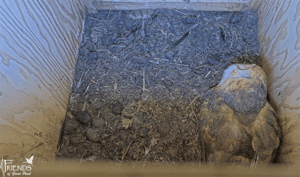
 A pair of barn owls staying in Goose Pond Fish & Wildlife Area’s nest box has produced eggs. You can watch this couple as they prepare for the hatch at on.IN.gov/goosepondfwa, then scroll to the middle of the page to the link that says, “view live feed from the Visitors Center.”
The laying season for barn owls can begin as early as March, and their clutch usually contains four to seven eggs, according to state ornithologist Allisyn Gillet. Barn owls usually lay once every two to three days and start incubating their eggs right away. Once the barn owl chick is fully developed, after 29-34 days, the chick will use an egg tooth to break through the shell in a process called pipping. It can take more than 12 hours for the chick to hatch completely from the egg after pipping. The eggs at Goose Pond started to appear around mid-April, so their hatch date would be sometime in mid-May.
Once the eggs have hatched, a male will bring in small mammals that the female then tears into small pieces to feed their owlets. Because the hatching doesn’t happen all at once, the older owlets that hatch first are usually stronger. If there are plenty of resources, all the owlets in a clutch have a good chance of survival, but if resources are scarce, only the stronger, older owlets may survive. DNR does not interfere in these routine natural events.
Barn owls are an endangered species in Indiana due to grassland habitat loss. Fewer than 50 nests are found annually in Indiana. To provide barn owls with secure nesting sites that are protected from predators, the DNR has built more than 400 nest boxes and erected them in barns and other structures with suitable habitat over the last 30 years.
The nest box at Goose Pond was first completed in March 2022 and first occupied in February 2024.