
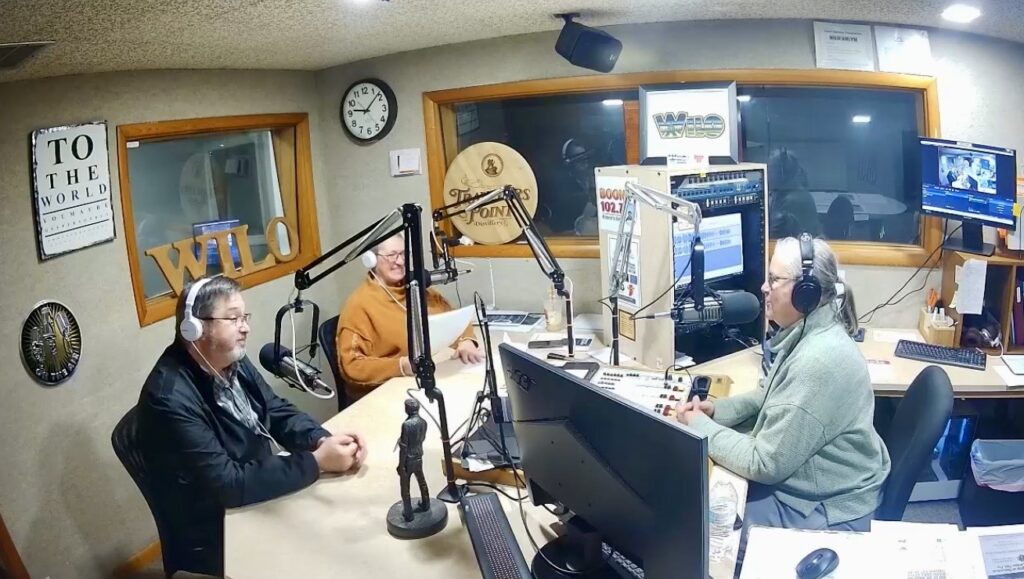
Clinton County Prosecutor Anthony “Tony” Sommer used a recent appearance on WILO’s “Party Line” program to outline his support for shifting more prosecutorial costs to the state, explain how Immigration and Customs Enforcement (ICE) already operates in the community, and weighs in on emerging voter ID and citizenship debates.
Legislative session and prosecutor funding
Sommer told WILO and Boone 102.7 FM hosts Cindy Loveless and Melissa Miller that the current Indiana General Assembly is in a non-budget, or “short,” session that is scheduled to conclude around March 12, with bills now moving through their second chamber and lawmakers making limited “tweaks” rather than major fiscal changes. He said one of the “big things” under discussion is a renewed push to adjust how local prosecutor offices are funded, a concept he said was generally well received last year but was considered too costly to include in the biennial budget.
Currently, Sommer explained, the elected prosecutor and chief deputy are paid by the state, while all deputy prosecutors, investigators, paralegals and other support staff are paid from the county’s general fund. He said new state policies have steadily expanded prosecutors’ responsibilities, including representing the Bureau of Motor Vehicles in licensing matters and handling additional hearings under Indiana’s expungement laws, which often reopen cases 15 to 20 years after they were resolved.
Sommer said those mandates have forced him to seek more staff from the Clinton County Council, which he described as “very supportive,” noting he now has more full-time deputy prosecutors than ever, all funded locally. He said the proposal at the Statehouse would recognize that many prosecutorial functions are “state-related” and give the state a larger role in helping pay for deputy prosecutors and support staff, thereby reducing pressure on county general funds.
Sommer added that a similar argument could apply to trial courts, where judges are paid by the state but court staff are funded by counties, though he said he has seen less discussion so far about expanding state support on the judicial side. He contrasted that with defense services, where the state already reimburses counties for a portion of public defender costs if they meet certain standards and submit claims, partially offsetting county expenses in criminal cases.
Technology, training and local priorities
Asked about equipment and technology needs, Sommer said all computers, software and other day-to-day tools in his office are purchased with county funds overseen by the county commissioners. He noted that office computers are replaced on a rotating schedule as budgets allow and said his own primary work computer is about five years old and still running Windows 10.
Sommer said his office also controls infraction deferral and pretrial diversion funds that can legally be used for training and equipment. He said he tries to dedicate those dollars first to local law enforcement training and equipment, and only occasionally to office technology or staff training, emphasizing that helping police agencies remains the top priority for those sources.
Call-in questions on habeas corpus, DOJ, ICE
During the live call-in segment, a caller asked Sommer to clarify the meaning of habeas corpus, referencing a high-profile exchange involving a national political figure. Sommer responded that habeas corpus is a legal writ a person can file to challenge their detention and force a court to decide whether their custody is lawful.
The caller also raised recent national coverage of a large banner of President Donald Trump displayed at the U.S. Department of Justice (DOJ) building. Sommer said DOJ has traditionally tried to maintain neutrality and independence from the rest of the executive branch but argued that Trump has “challenged those norms” by insisting DOJ operate more directly under presidential control. He said he believes it is best for DOJ to remain neutral and objective but acknowledged he does not set federal policy.
On ICE, Sommers was asked if a pending “ICE bill” at the Indiana Statehouse would put local agencies under ICE authority and whether ICE could “just come in” to Clinton County. Sommer said the current proposal would formally authorize local police to cooperate with ICE by detaining people suspected of being in the country illegally until they can be turned over to federal authorities, turning what has been a patchwork of voluntary agreements into a statewide standard.
He said ICE already has full federal authority “border to border” and has long operated in Indiana and Clinton County, routinely visiting the local jail to interview inmates and place holds in appropriate cases, as well as periodically inspecting workplaces. Sommer described ICE’s local presence as generally “invisible,” noting that he often heard about their activities before he ever saw an agent in person, and said he has not heard of agents “dragging people out of school” in the community.
Election records, voter ID and citizenship
Sommers was also asked how long local election ballots are kept. Sommer replied that the Clinton County clerk of courts, not the prosecutor, is responsible for election records. He said public record schedules generally specify retention periods and some records fall into a “forever” category, often with digital storage rather than paper. For ballot records generated by voting machines, he said he believed the data likely remains electronic and is kept in secure areas by the clerk, though he did not know the exact retention standard.
The conversation then shifted to a reported executive order on voter ID that would require voters to present not only photo identification, but also an additional document such as a birth certificate or visa at the polls. Sommer noted that Indiana already has “motor voter” registration when residents obtain a driver’s license and a photo ID requirement at polling places, and he said Hoosiers already had to show a birth certificate and, in some cases, marriage records to obtain Real ID–compliant licenses used for air travel.
Sommer said if new federal rules required voters to bring those documents to the polls, Indiana residents would likely adapt, though he acknowledged many people struggle to locate official birth or marriage certificates and might need assistance from health departments or clerks. Sommer questioned whether voters with Real ID–compliant licenses should have to bring additional documents, noting that Indiana has already implemented stricter ID standards.
Sommer said the larger dispute in Washington centers on whether proof of citizenship should be required to vote in federal elections, adding that Republicans generally argue voting is a right of citizenship, while many Democrats fear strict documentation rules could suppress turnout among minorities and immigrants if enforced unevenly. He said that in his view, non-citizens should not be able to vote in local or federal elections, and said he supports citizenship and ID requirements while also urging policymakers to seek “common ground” and avoid turning the issue into a purely “fiery” partisan fight.
Local events highlighted
Before signing off, WILO reminded listeners that the next Legislative Breakfast, hosted by the Clinton County Chamber of Commerce, will be held Saturday morning at Wesley Manor, 1555 North Main Street in Frankfort, giving residents another chance to engage directly with state lawmakers.