Frankfort Municipal Utilities General Manager Todd Corrie told WILO’s “Party Line” that the City of Frankfort has the water, sewer and electrical capacity to support a data center, calling the increasingly common topic the “elephant in the room” in local economic development conversations.
Corrie appeared in-studio Thursday with host Shan Sheridan.
“When you start looking at it commonsensically, if we have the capacity, if we have the infrastructure and we have the opportunity, why would we not want to have that benefit?” Corrie said.
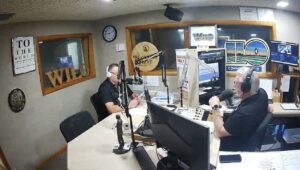
Corrie said public worry about data centers typically centers on two things — water use and electric rates — but he said Frankfort is well-positioned on both fronts. On the power side, Corrie pointed to the jointly owned 230-kilovolt substation sitting north of the former Conagra property, owned by Duke Energy, IMPA and Wabash Valley, which he said still has available capacity. “Power is becoming harder and harder to get,” Corrie acknowledged, “but it doesn’t matter — there are companies out there, whether it’s a data center or not, that are going to pull a lot of power.”
He noted that several existing local employers already draw comparable amounts of electricity and water without triggering rate hikes for residents, citing a $40 million expansion by ADM, a $75 million expansion recently completed by Donaldson, and a possible new expansion from NTK. Frito-Lay, he said, now uses roughly 1.5 million gallons of water a day, up from about 900,000 gallons two decades ago, while continuing to employ more than 1,700 people locally. “If everything is managed correctly and everybody watches our Ps and Q’s, we can do it,” Corrie said.
Corrie offered a comparison meant to reframe how residents think about data centers versus traditional heavy manufacturing. Frankfort recently turned down a manufacturing project that would have required major expansions of the water and wastewater plants and generated roughly 250 truck trips and 20 rail car movements a day. “Do you want more of that?,” Corrie asked, “or do you have the opportunity to get a data center that has a hundred cars in the parking lot?”
Utility Infrastructure Investments Underway
Much of Frankfort’s ability to court new industry, Corrie said, comes down to infrastructure already in the pipeline. Corrie said water and sewer service out to State Road 65 is largely complete. The remaining piece is a new lift station and running waste water directly to the treatment plant — a project Corrie estimated at $10 million to $12 million that is expected to go under construction within the next year and become operational sometime in the second or third quarter of 2028.
That project matters beyond industrial growth, Corrie said, because the existing lift station near Suncrest School is already at capacity. “We can’t even add a house to that lift station right now,” he said. Once the new lift station is online, it will free up room for potential housing growth, which Corrie said is currently concentrated in the southeast corridor near the Meadow Brook and Southridge developments — growth he said has been slowed somewhat by high interest rates.

Corrie also described a shift in what companies look for when scouting sites. Where developers once sought five or ten acres to build modest facilities, he said many now want a fully built structure of 250,000 to 300,000 square feet facility ready to lease, on sites of 300 to 500 acres — a scale that’s difficult for smaller communities to offer. He cited Caterpillar’s roughly $800 million expansion in Lafayette as an example of the size of projects now competing for regional sites.
Asked what he’d change with a “magic wand,” Corrie said his top wish is a fourth electrical substation to improve system reliability and take load off aging equipment, but said rising land costs and the difficulty of finding an ideal location have stalled progress. “We just been striking out on that part of it,” he said.
Heavy Rain Strained Storm Drainage Last Week
Corrie also discussed the recent stretch of heavy rain, including a storm last week that kept crews busy responding to flooded streets until nearly midnight. He said the city received roughly eight to nine inches of rain over a 10-day period, saturating the ground and overwhelming catch basins in spots including Paris Street and East Wabash. “As long as the catch basin is flowing, there’s really nothing we can do — you just have to give it time,” Corrie said.
He credited past infrastructure investment for preventing the kind of flooding the city’s east side saw in years past, when areas including Case Arena took on water during extremely heavy rainfall events. “Whoever designed and engineered that work deserves a pat on the back,” Corrie said, adding that infrastructure spending rarely gets public attention. “Nobody likes to talk about it because it’s not the sexy thing… but if you don’t have good infrastructure, you’re not going to attract new homes or new businesses.”
The City of Frankfort is conducting a Survey to help City Leaders and Planners determine priorities for Frankfort. Over 500 people have participated in the survey to date. To participate in the survey, CLICK HERE.