FRANKFORT, Ind. — Expanding access to higher-ethanol fuel and updating federal farm policy are top priorities for Indiana agriculture, according to Indiana Corn Growers Association President Alan Dunn, who spoke with hosts Cindy Loveless and Melissa Miller Friday on WILO and Boone 102.7 FM’s “Party Line.”
Dunn said the organization is currently focused on federal action to allow year-round sales of E15 gasoline, a blend containing 15% ethanol, as a way to increase demand for corn and support farm income during a period of low commodity prices.
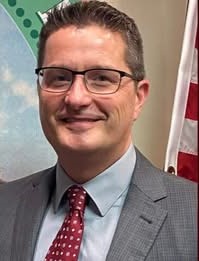
“We’re trying to get the nation to at least have the ability… to contain 15% ethanol,” Dunn said. “It’s not a mandate… but it would use potentially billions of bushels of corn. So it’s a big deal.”
Dunn, who also serves on the Clinton County Council and the Frankfort Airport Board, discussed a range of issues affecting local farmers and economic development, including trade policy, fertilizer costs, infrastructure needs and long-term planning for growth in Clinton County.
Farm bill, trade and input costs
In addition to ethanol policy, Dunn said updating the federal farm bill remains a key concern. While portions of the legislation were addressed in earlier federal action, several programs — including conservation and research funding — are still awaiting reauthorization.
Dunn said he plans to travel to Washington, D.C. in July to meet with lawmakers on both E15 and farm bill priorities. Dunn also addressed global trade, noting agriculture’s reliance on export markets, particularly China.
“When they (China Crop Purchases) are not there, it’s really negative to prices. When they are there, things operate pretty smoothly,” he said, referring to soybean exports. Recent agreements to purchase U.S. soybeans have improved the outlook, Dunn added, saying, “Things look pretty promising… if all of that comes to pass.”
However, he pointed to fertilizer costs — especially tariffs on imported phosphate — as an ongoing concern for farmers’ bottom lines. “If we want to help the farm economy… why wouldn’t we pull that tariff off?” Dunn said. Most phosphates for ag fertilizer come from Morocco, Dunn said.
Ethanol industry and infrastructure
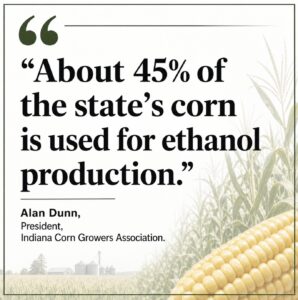
Indiana’s ethanol industry remains a major economic driver, with Dunn noting that about 45% of the state’s corn is used for ethanol production.
The state currently has 14 ethanol plants, with expansions underway. Dunn said one emerging challenge is transporting byproducts such as distillers grains to broader markets.
A growing focus, he said, is improving access to container shipping through ports like Burns Harbor and along the Ohio River. “That would benefit way beyond just agriculture,” Dunn said, noting broader economic implications for manufacturing and logistics.
Weather and market outlook
Dunn said weather remains a key uncertainty, particularly with the arrival of an El Niño pattern that could bring wetter conditions during harvest. “I think what I worry about… is a wet fall,” he said. “They’re no fun… long falls with a lot of mud.”
At the same time, he noted that weather challenges in South America could tighten global supply and potentially support higher prices for U.S. farmers.
Airport strategy and local development
On local issues, Dunn discussed strategic planning for the Frankfort/Clinton County Airport, emphasizing upgrades over expansion. Rather than extending the runway — a costly project dependent on federal funding — the airport plans to groove the existing runway to improve aircraft performance. “At a tiny fraction of the cost, we’re going to groove our runway,” Dunn said. “That will allow us to take a larger category of aircraft.”
Dunn said the airport is viewed as a key economic development asset, helping attract businesses to the region.
Growth, housing and tax structure
Dunn also addressed broader economic challenges facing Clinton County, particularly in light of changes to Indiana’s local tax structure that will shift reliance from property taxes toward income taxes.

“We don’t need new taxes, we need new taxpayers,” he said.
That shift, he explained, increases the importance of attracting residents — not just jobs — so that local income tax revenue stays within the county. “We need to create the jobs and then we need them to live here to really fully benefit,” Dunn said.
He added that housing development and additional hotel capacity are both needed to support economic growth, citing past missed opportunities tied to limited lodging options.
Dunn said he expects to see new development activity in the near future, particularly along the Interstate 65-28 corridor, as regional growth from Lafayette and Boone County continues to expand into Clinton County.